Zhong Kui, Demon Queller — Blackwork
blackwork · black · portrait
back · upper-arm
$29
钟馗Zhōng Kuí
also known as: The Demon Queller, King of Ghosts, Chung Kuei, Shōki
Failed by the empire for his ugly face, he came back from death as the one thing every demon in China fears.
钟馗The earliest written version of the legend survives in an 11th-century source: the Song-dynasty polymath Shen Kuo, in his Brush Talks from Dream Brook, quotes a Tang-era inscription describing how Emperor Xuanzong fell ill with malaria after a military review at Mount Li. In his fever dream a small demon in a red loincloth — a creature called Xuhao, "Emptiness and Decay" — stole his consort Yang Guifei’s perfume sachet and the emperor’s own jade flute. Then a giant appeared: he gouged out the little demon’s eyes and ate it whole. The giant introduced himself as Zhong Kui, a man who had failed the military examinations and now swore to rid the emperor’s realm of every last demon. Xuanzong woke cured, summoned the court painter Wu Daozi to paint the figure from his dream, and ordered the image distributed across the empire to expel evil at year’s end. A later Tang source, the Tang Yishi, gives Zhong Kui a fuller biography: a scholar from Mount Zhongnan who, denied his degree in the Wude era, dashed his head against the palace steps and died protesting the injustice — the emperor, shamed, had him buried in an official’s robe. Qing-dynasty novels such as The Queller of Demons (Zhankui Zhuan) and the beloved tale of Zhong Kui escorting his sister to her wedding — painted as early as the Song and Yuan dynasties — rounded out the legend we know today.
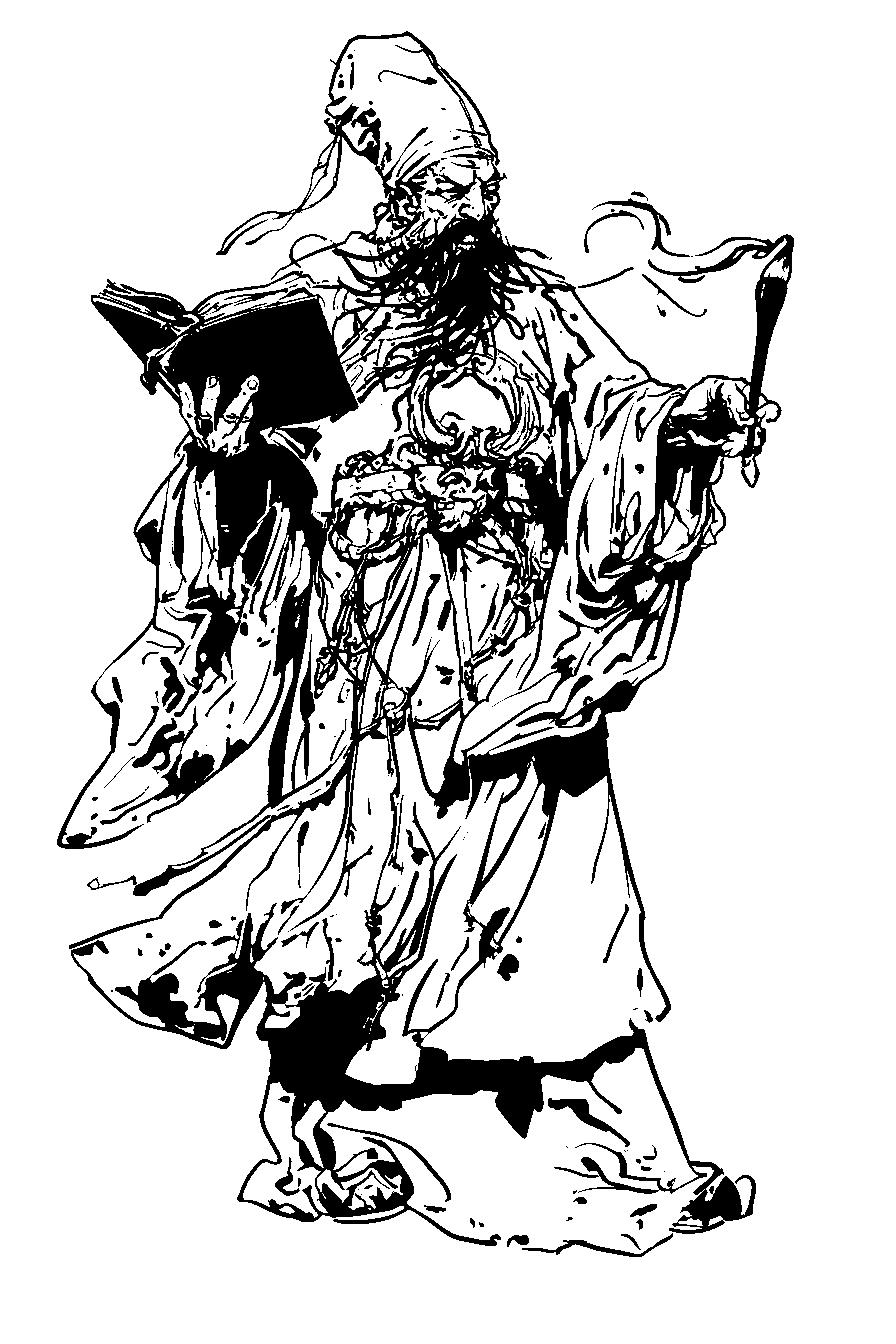
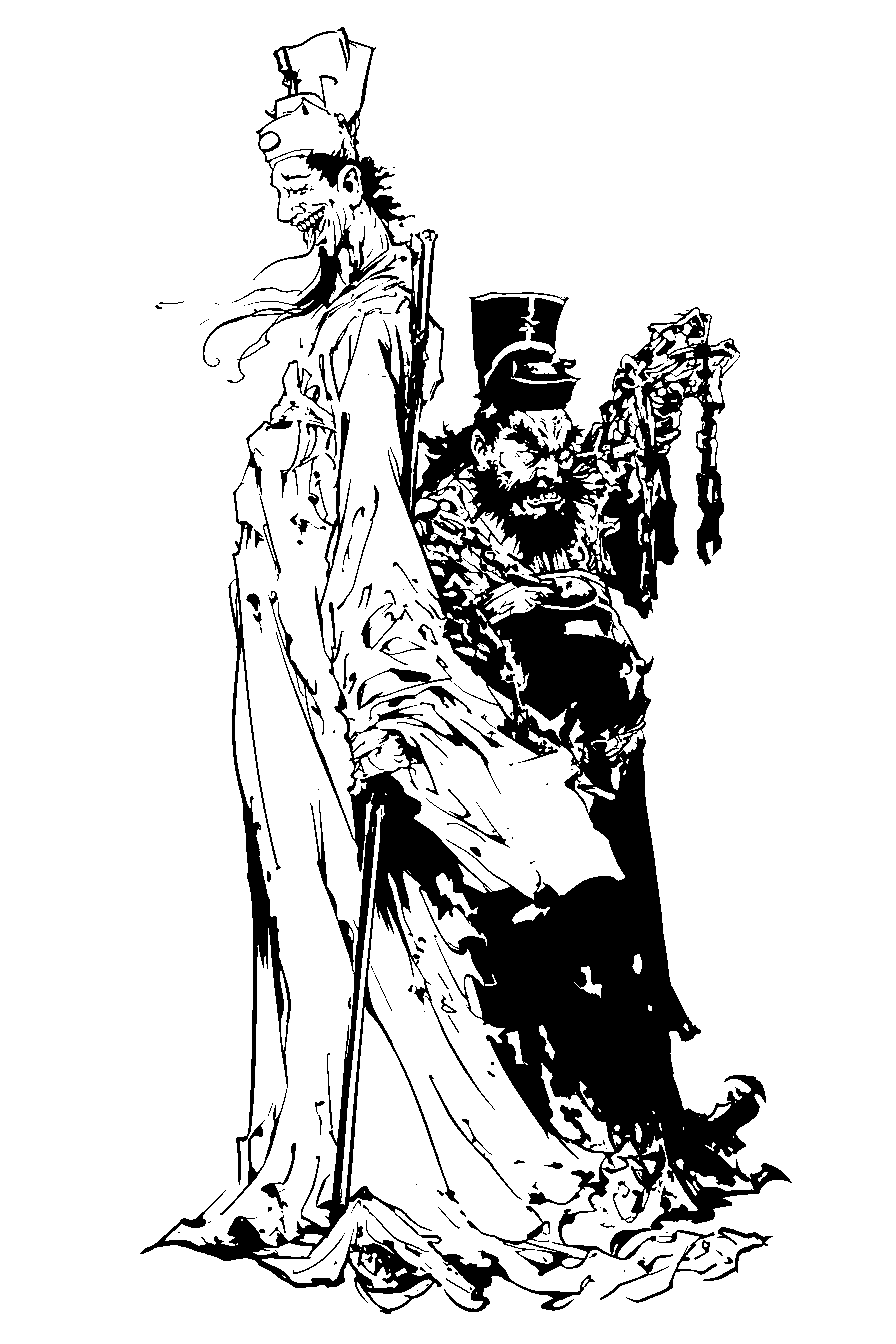
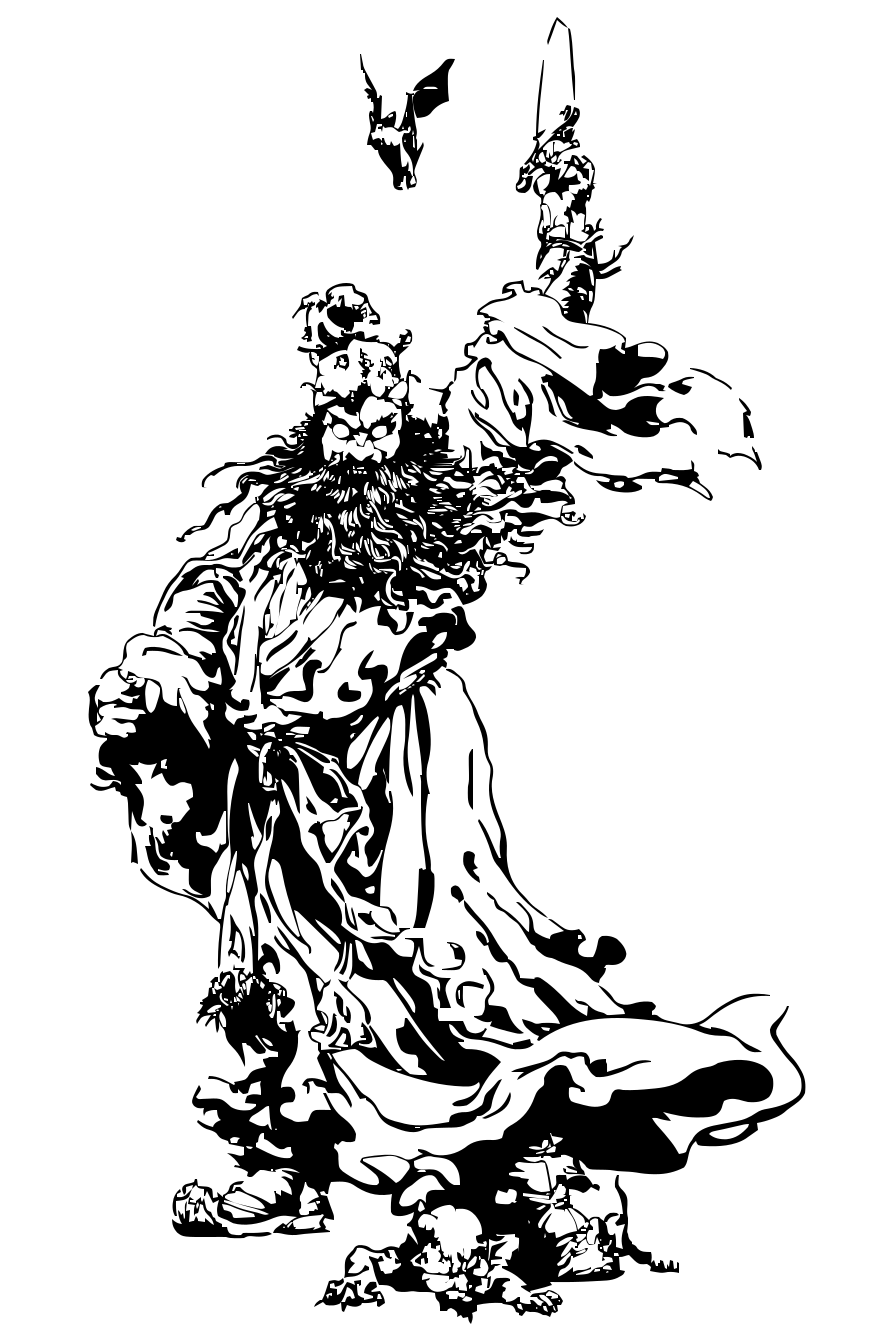
Zhong Kui is instantly recognizable: a leopard-like head with round, glaring eyes, an iron-dark face, and a curling, bristly beard — the canonical description fixed by the Qing novel The Queller of Demons. He wears the costume of the degree candidate he died as: a battered black gauze cap (the "broken hat" of the Tang Yishi) and an official’s robe, recorded in Tang and Song sources as blue with a horn belt, and reimagined from the Ming-Qing era onward in lucky vermilion red. His standard attributes are the demon-quelling sword and, hovering above him, a bat — in Chinese, "bat" (fu) is a perfect homophone of "fortune" (fu), so Ming-Qing New Year prints show Zhong Kui looking up at a descending bat in compositions titled "Fortune Before Your Eyes." One note for collectors: the "Seven-Star Sword" name you will see online belongs to opera and Daoist ritual usage; its textual basis in the old literature is weak, so we describe his blade simply as the demon-quelling sword. Small, terrified demons — being eaten, trampled, or carrying his sedan chair and umbrella — complete the scene, drawn from Song-Yuan paintings such as Gong Kai’s famous Zhongshan Excursion.
Where does the name come from? The scholarly mainstream follows the Qing philologist Gu Yanwu, who argued in his Record of Daily Learning that "Zhong Kui" is a phonetic shift of zhongkui (终葵), an old word for a mallet or club. The word appears in the Rites of Zhou and in the ancient dictionary Fangyan ("the people of Qi call a club zhongkui"), and exorcists in the nuo rituals of ancient China drove off demons with weapons — club in hand, the word hardened into a personal name with protective power. Six Dynasties records back this up: people were literally named Zhongkui with the courtesy name Bixie, "Warding Off Evil." The mallet became a man, and the man became China’s ghost-catcher general. From there his career only grew: Tang emperors gifted Zhong Kui paintings to their ministers at year’s end, the nuo exorcism dances of the Song had him lead the procession, and by the late Ming his portrait was being hung at the Dragon Boat Festival to repel the "five poisons" and plague. A living folk opera tradition, "Tiao Zhong Kui," still survives in Huizhou today.
A Zhong Kui tattoo is, first and last, protection. He is the demon-eater: in Chinese folk logic his ferocity points outward, away from the wearer, toward whatever threatens them. But the bat pun makes him double-edged in the best way — he does not merely repel evil, he pulls fortune down out of the sky. Expel and attract: that duality is the heart of the image. Layered on top is the story of the man himself, and this is what resonates with modern wearers: brilliant, ugly, cheated, furious — and unkillable in his defiance. Zhong Kui is an underdog who became a god. One important distinction for Western collectors: the image you may already know as "Shōki the Demon Queller" from Japanese irezumi is the same figure through a different lens. Japanese Shōki arrived via Edo-period ukiyo-e (Harvard Art Museums catalogs him exactly as "Shōki (Chinese, Zhong Kui) the Demon Queller") and developed his own iconography — a stockier ukiyo-e anatomy, irezumi compositional conventions, meanings of discipline and resistance to chaos. The classical Chinese Zhong Kui reads differently: broken gauze cap, vermilion official’s robe, the scholar’s tablet at his belt, the bat overhead, ink-painting or New-Year-print flatness rather than ukiyo-e muscle. If you want the Chinese original, tell your artist which tradition you mean — the difference shows. And expect Zhong Kui’s stock to keep rising: Game Science announced Black Myth: Zhong Kui with a CG teaser at gamescom 2025 and released roughly 15 minutes of in-engine gameplay footage in August 2026, though the studio has never announced a release date — the 2028–2029 window you will see cited is media speculation, not official word. Note that the game’s armored, tiger-riding redesign departs sharply from the classical robe-and-bat iconography discussed here.
In Chinese folk tradition, Zhong Kui is considered a "heavy" image — saturated with sha qi, a killing or intimidating aura — and tattoo folklore holds that only a person with a "hard fate" (a strong enough destiny) can safely carry him on their skin. Folk custom says to have your fortune read first; some circles warn that wearing Zhong Kui while visiting graves or attending funerals may "frighten the ancestors," and advise keeping the tattoo out of "unclean" places such as nightclubs and toilets. We present these as folk beliefs, not facts — our aim is to explain the culture, not to preach superstition. There is a genuine cultural logic underneath them worth knowing: orthodox Zhong Kui practice hangs his image on doors and walls, ferocity facing outward to guard a threshold. Wearing him inside the threshold, against your own skin, inverts that architecture — and that inversion is the real root of the Chinese taboo talk. On the other side of the ledger sits the popular rhyme "Zhong Kui on your back, a power of your own" — plenty of people wear him proudly and prosper. In short: understand what the image means to the culture it comes from, wear it respectfully, and choose for yourself.
Each design includes the color reference, line art and a print-ready stencil. Instant download; take it to any tattoo artist.
blackwork · black · portrait
back · upper-arm
Chinese folk tradition says Zhong Kui’s aura is "heavy" — some believe only a person with a strong destiny can carry him, and that the tattoo should stay away from funerals and "unclean" places. These are folk beliefs, not facts. Culturally, Zhong Kui is a protective figure whose ferocity is aimed at demons, not at you, and a popular rhyme — "Zhong Kui on your back, a power of your own" — treats the tattoo as empowering. Knowing the lore and wearing it respectfully is what matters.
Protection against evil and misfortune is the core meaning — Zhong Kui is the demon-eater. Because the bat (fu) that accompanies him is a homophone of "fortune" (fu), the image also attracts luck, making it a rare expel-and-attract double symbol. His biography adds a modern layer: a brilliant man cheated of his honors for being ugly, who turned his fury into purpose. Many wearers choose him as a guardian and an emblem of defiance against superficial judgment.
Same figure, two iconographic traditions. Shōki is the Japanese reading of Zhong Kui’s name, popularized in the West through Edo-period ukiyo-e and irezumi — expect ukiyo-e anatomy, irezumi composition, and meanings around discipline and resistance to chaos. The classical Chinese Zhong Kui keeps his scholar-official costume: broken gauze cap, vermilion robe, belt tablet, the lucky bat overhead, and subdued demons, in an ink-painting or New-Year-print sensibility. Tell your artist which tradition you want; the silhouettes are visibly different.
Probably, at least in the short term — Game Science’s CG teaser (gamescom 2025) and the ~15-minute gameplay reveal (August 2026) introduced a red-haired, fully armored Zhong Kui who rides a tiger, and that look will inevitably reach tattoo studios. Just know it is a game redesign, not the traditional iconography. Also note the studio has never announced a release date; the "2028–2029" dates circulating online are media speculation. If you want the classical image, the reference points are the robe, the broken hat, the sword, and the bat — not the armor and tiger.
Neither label quite fits, which is part of his appeal. He began as a wronged man, died, and was posthumously empowered as a queller of demons — in Chinese folk religion he functions as a protective deity and door god, honored at year’s end and at the Dragon Boat Festival. He commands ghosts rather than being one of them.